
One Meal, Two Plates — Cook One Recipe for Two Different Diets
The complete method for couples: cook one shared meal and plate it two ways — different calories, different macros, same pan. Works for weight loss + muscle gain, vegetarian + omnivore, or any combination of goals.
The whole thing comes down to one meal, two plates, different portions: you cook a single shared recipe once, then plate it into two servings sized for two different goals — one lighter, one heavier, the same pan, the same cooking time. The food is shared. Only the portions and the macro balance diverge. This guide covers the full method: how to pick a base recipe that works for both of you, how to work out each plate’s target, how to do the split on a Tuesday night with what’s already in the kitchen, and how the same idea solves the version of this problem that has nothing to do with weight.
What is one meal, two plates?
One meal, two plates is a cooking method where you prepare a single shared recipe once and serve it as two differently sized portions, each balanced to hit a different person’s calorie and nutrition target. It is sometimes called adaptive cooking or adaptive plating. The cooking step is shared; only the plating diverges.
It exists because of the most common kitchen problem couples have: two people, two goals, one stove. One of you is trying to lose weight and sits around 1,500 calories a day. The other is trying to build muscle and needs closer to 2,800. Cook two separate meals and you’ve doubled the washing-up and halved the evening. Cook one meal and eat identical portions and one of you misses your target every single night. The middle path — cook once, plate twice — keeps the cooking shared and the goals separate. You eat together without either of you eating the wrong thing.
The method scales well beyond calories. The same shape handles a vegetarian and an omnivore, a partner on a lower-carb plan and one who isn’t, a pregnancy that needs extra iron next to a cholesterol plan that leans the other way, a small appetite that needs calorie density next to a large one that needs volume. In every case the solution is identical: one base, two plates, two sets of needs met from a single cooking session.
It also answers a quieter problem. The partner who currently plans, shops and cooks for a household with mismatched needs is quietly running two meal plans inside one head. Collapsing those into a single plan with a fork at the end is as much a relief for the mental load as it is for the macros — which is the same reason the nightly what’s-for-dinner argument wears people down.
The core method
The method has three moving parts. Get them in the right order and the rest follows.
1. Start with one shared base recipe
The base recipe is the thing you actually cook — the full, unsplit version, made once for both of you. The trick is picking something modular: a protein, a carbohydrate, a vegetable, and usually a sauce or a fat. Lemon herb chicken with quinoa and greens. A stir-fry with rice. A traybake with potatoes. A pot of chilli with cornbread on the side.
Modular bases are what make the split possible. A one-pot stew where everything is tangled together is hard to portion by goal — once the meat and the rice are married in the pan, you’re guessing at the split. A base where the protein, carb and veg sit as separate components lets you dish out different amounts of each at the end, with no extra cooking.
A simple test: can you make this meal bigger for a hungry partner by adding more rice, and smaller for a partner in a deficit by adding more greens, without cooking anything extra? If yes, it’s an adaptive base. If no — say, a tightly composed lasagne — it can still work, but the split happens at the ingredient level before it goes in the oven, not at the pan.
2. Work out each plate’s target
Every plate has a job: land near a specific number of calories, with enough protein to protect muscle and enough carbohydrate and fat to make the meal feel like a meal. That number comes from each person’s daily target.
Daily calorie needs come from your TDEE — Total Daily Energy Expenditure — which is your resting metabolic rate multiplied by an activity factor. The resting rate is most often estimated with the Mifflin–St Jeor equation, published in the American Journal of Clinical Nutrition in 1990 and still the standard for healthy adults. From there you subtract for fat loss and add for muscle gain. The US Dietary Guidelines put adult daily needs anywhere from roughly 1,600 to 3,000 calories depending on sex, age, size and activity — which is exactly the spread that makes one-size-fits-all portions fail at the dinner table.
For a single meal, a reasonable rule is that dinner lands around 30–35% of the day’s total. So a 1,500-calorie day might aim for a 450–525 calorie dinner, and a 2,800-calorie day might sit around 840–980. You can check the calorie and macro content of any ingredient on the USDA FoodData Central database. You do not need to hit your number to the single calorie. You need to be in the right postcode, meal after meal, and the maths takes care of the rest.
Running these sums for every dinner gets tedious — it’s the boring kind of arithmetic. CookTwo’s adaptive cooking does the TDEE working-out and the portion split for you, so you see both plates without the calculator. But the method below works just as well by hand, and it’s worth knowing what’s happening underneath.
3. Plate differently, cook once
This is where the two plates actually diverge. You cook the full recipe — all of it, for both of you, in one pan — and then, at the very end, you plate.
The levers you pull, in rough order of how much they move the total:
- Carbohydrates. Rice, pasta, bread, potatoes, grains. The cheapest calorie lever and the one that shifts the total fastest. The bigger plate gets more; the smaller plate gets less, sometimes none.
- Added fats. Oil, butter, cheese, nuts, avocado. Small in volume, large in calories. A drizzle of oil and a grate of cheese on the bigger plate can add 150 calories in seconds.
- Protein. Keep this adequate on both plates — it protects muscle in a deficit and builds it in a surplus — but the bigger plate can carry a larger portion.
- Vegetables. The free lever. Volume, fibre, very few calories. The smaller plate leans on extra veg to stay full without overshooting the target.
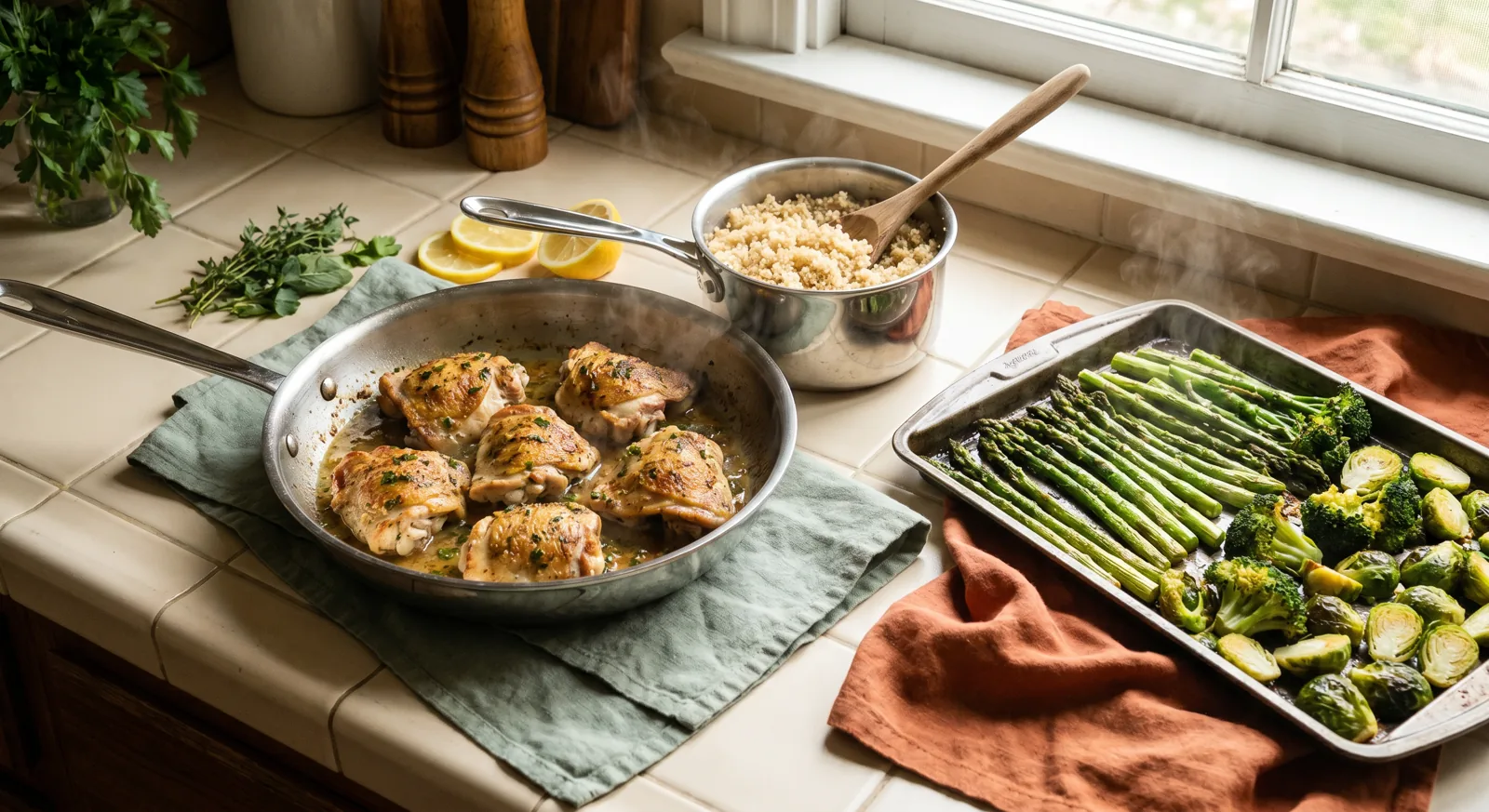
One pan leaves the stove. Two plates leave the kitchen. The cooking time, the washing-up and the cognitive load are all for one meal — even though two different goals are being served.
A worked example: Tuesday night
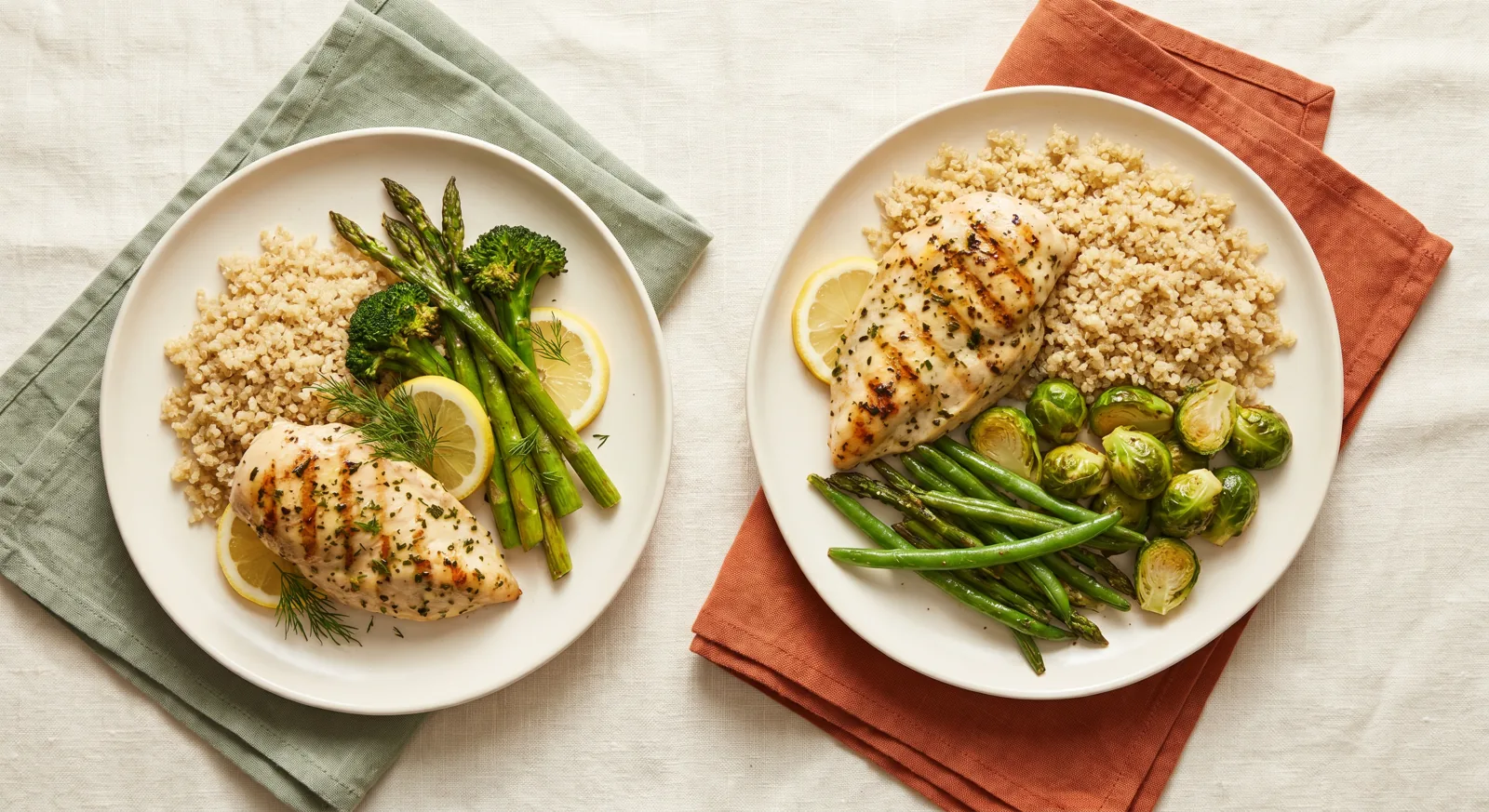
Let’s make it concrete. Dinner is lemon herb chicken with quinoa and roasted greens. You’re cooking for a 1,500-calorie day (fat loss) and a 2,800-calorie day (muscle gain). The chicken goes in one pan, the quinoa in one pot, the greens on one tray. Total cooking effort: one meal.
At the plate, it splits like this:
| Plate | Goal | Chicken | Quinoa | Greens | Olive oil | Calories | Protein |
|---|---|---|---|---|---|---|---|
| A | Fat loss | 120 g | ½ cup | extra | 1 tsp | ~470 kcal | ~38 g |
| B | Muscle gain | 180 g | 1¼ cups | standard | 1 tbsp | ~760 kcal | ~55 g |
One pan. Two plates.
Same chicken, quinoa and greens — different portions, different goals.
Plate A · Fat loss
~470 kcal
120 g chicken · ½ cup quinoa
extra greens · 1 tsp oil
~38 g protein
Plate B · Muscle gain
~760 kcal
180 g chicken · 1¼ cups quinoa
standard greens · 1 tbsp oil
~55 g protein
Same chicken. Same quinoa. Same greens. Partner B gets half as much protein again, two and a half times the rice, and triple the oil. Partner A gets a mound of extra greens so the plate still looks full. One pan of each component; two plates that serve two different goals. The cooking was shared. Only the plating diverged.
A Tuesday-night version of the same flow, step by step:
- Pick the base. Something modular — protein, carb, veg, sauce.
- Set two targets. Roughly a third of each person’s daily calories, with protein on both plates.
- Cook it all, once. Full recipe, both portions, one set of pans.
- Plate the smaller portion first. Add extra veg to fill it.
- Give the rest to the bigger plate. Top up with extra carb and fat.
- Sit down together. Same meal, two goals, zero arguments about whose dinner this is.
The numbers above are a worked example, not a prescription — yours depend on your body, your day and your training. The method is what matters: pick the base, set the two targets, move the levers. If you want the full macro-by-macro version, including how to hold a protein floor on a cut, we go deep on that in how to cook one meal for two different macros.
Other common pairings
The cut-and-bulk couple is the headline case, but the same levers handle the pairings that show up more often in real kitchens:
- Maintenance and deficit. One of you is holding steady, the other is losing. The maintenance plate is the baseline portion; the deficit plate drops the carb and the added oil and piles on extra veg instead. Same meal, roughly 250 calories apart.
- Bulk and maintenance. The mirror image. The maintenance plate is the normal serving; the bulk plate adds a side of rice, an extra 30 g of protein and a drizzle of oil. Around 300 calories apart.
- Two maintenance goals, different training days. Similar calorie targets, different days. On a training day the partner who trained gets more carbs on the plate; on a rest day the portions even back up. The base recipe never changes — only the plating does.
The shape of the solution holds across every combination: cook the shared base once, then move the carbohydrate, fat and vegetable levers until each plate lands where it needs to.
When the difference isn’t just calories
The same method handles the version of this problem that has nothing to do with weight — and it’s worth seeing how, because “one meal, two plates” gets reduced to cutting and bulking more often than it should.
Different diets. One vegetarian, one not. Cook the base vegetarian — the grain, the veg, the sauce — and add a separate protein to the omnivore’s plate. A quick pan-fried chicken breast or piece of fish, done in the same pan after the shared components come out. One meal, two plates, two dietary worlds, and the vegetarian half didn’t require a second dinner.
Different medical needs. A pregnancy that needs iron-rich foods next to a cholesterol plan that leans plant-based and lower in saturated fat. The shared base does the heavy lifting; the plating tilts toward each person — extra lentils and spinach on one plate, a leaner protein portion and more soluble fibre from oats or beans on the other. Same method, different constraints.
Volume versus density. One partner eats high-volume, low-calorie-density food to stay full in a deficit. The other is the opposite — a small appetite that needs calorie-dense food to gain anything at all. The smaller plate piles on the veg; the bigger plate concentrates calories into oil, cheese, nuts and carbs. Two people who eat in opposite ways, fed from one pan.
In every case the shape of the solution is the same: one shared cooking step, two personalised plates. That is the whole idea, and it’s why the method travels so well across goals — it’s a structure, not a recipe. (For the deeper treatment of dietary mismatch — vegan and omnivore, keto and not, allergy and not — the sibling pillar on cooking for two different diet plans is where that lives.)
There’s a budget and waste angle hiding in here too. Cooking one adaptive base for two people, from what’s already in the kitchen, beats the alternatives on cost. Meal kits charge a premium for the convenience and ship portions that rarely match two different goals; takeout solves tonight and apologises to your bank balance tomorrow; cooking two full meals doubles the ingredients, the time and the odds that something goes off in the back of the fridge. One meal, two plates uses a single set of ingredients, scaled two ways — which is also the foundation of a pantry-first approach and a quiet win for the weekly grocery bill.
Common questions
Can you cook one meal for two people with different calorie goals?
How do you split one meal into two different portions?
What if one person is vegetarian and the other eats meat?
Won't the smaller portion leave me hungry?
Do I have to weigh and count everything?
Related reading
- How to Cook One Meal for Two Different Macros — the full macro maths, protein floors and how to hit two targets from one recipe
- How to Stop the “What’s for Dinner?” Argument — the decision side of the same problem, and why a shared plan ends the nightly stand-off
- Couples Meal Prep Sunday — batching the one-meal-two-plates method across a week
- How to Meal Prep When One Partner Is Cutting and One Is Bulking — the fitness-couple version, end to end
- Pantry-First Cooking — the sibling pillar on building these meals from what you already have
- Cooking for Two Different Diet Plans — the sibling pillar on dietary mismatch (vegan and omnivore, keto and not, allergies)
One meal, two plates is not a diet, an app feature or a hack. It is a way of thinking about dinner when two people share a kitchen and do not share a goal — cook the shared thing once, then let the plate do the personalising. Once the method is in your hands, the question stops being “what are we each having?” and becomes “how do we plate this one?” That is a better question, and a far easier one to answer on a Tuesday night.
If you would rather not do the maths at the stove, CookTwo’s adaptive cooking takes a single recipe from your pantry and plates it two ways automatically — different calories, different macros, same pan. The method above is the whole idea; the tool just removes the arithmetic.