
How to Meal Prep When One Partner Is Cutting and One Is Bulking
The fitness-couple meal prep guide: one Sunday session, two completely different calorie targets, zero separate cooking. The full system from planning to plating.
The hardest pairing in the kitchen
One partner is cutting — eating 1,400–1,600 calories to shed fat, tracking every gram, training hard. The other is bulking — eating 2,800–3,200 to build muscle, chasing surplus protein, never missing a meal. The gap between your plates is the widest it can be: sometimes 1,500 calories or more in a single day.
This is the pairing that breaks most couples’ meal plans. The conventional advice — “just cook separate meals” — means two of everything: two recipes, two sets of pans, two shopping lists, twice the time. Most couples last about a week before one of them gives up and eats whatever the other one is having, goals be damned.
It does not have to be that way. The one meal, two plates method was built for exactly this scenario. You cook one set of food, and the two plates diverge so widely that they look like different meals — but they come from the same kitchen, the same session, the same effort. This post is the end-to-end system: targets, shopping, prep, and the daily plating for a cut-and-bulk couple.
Step 1: Set the two targets
Before you shop or cook, you need the numbers. The cut partner and the bulk partner each need a daily calorie target and a macro split. The Mifflin–St Jeor equation gives you the resting rate; from there, subtract 300–500 for a cut and add 300–500 for a bulk.
For this guide, we will use a common real-world pairing:
| Daily Calories | Protein | Carbs | Fat | Goal | |
|---|---|---|---|---|---|
| Partner A | 1,500 kcal | 140 g | 130 g | 45 g | Fat loss |
| Partner B | 3,000 kcal | 200 g | 380 g | 80 g | Muscle gain |
That is a 1,500-calorie daily gap. The macro maths behind these numbers is covered in detail in our guide to cooking for two different macros.
Step 2: Shop for one kitchen, not two
The shopping list is shared. You are buying the same ingredients for both of you — the difference is purely in how much ends up on each plate. For a five-day prep:
Shared base (both plates)
- 2 kg chicken breast
- 1 kg lean beef mince
- 2 kg rice
- 1 kg oats
- 1.5 kg mixed vegetables
- 2 dozen eggs
- 1 kg Greek yoghurt
Surplus add-ons (Partner B only)
- 500 g peanut butter
- 1 kg sweet potato
- 500 g nuts and trail mix
- Olive oil, cheese, avocado
- Mass gainer shake (optional)
Notice the pattern: the shared ingredients form the base of every meal. The surplus add-ons are calorie-dense extras that only go on Partner B’s plate — they never touch Partner A’s food. This is the key to cooking once and serving two wildly different targets.
Step 3: The Sunday cook
Two hours. One kitchen. Here is the batch:
- Oven: 1.5 kg chicken breast (seasoned, baked at 200°C for 25 min)
- Stovetop: 1 kg beef mince (browned with onion and garlic for chilli base)
- Rice cooker: 2 kg rice (enough for both partners all week)
- Oven tray 2: roasted vegetables (peppers, courgette, red onion, 30 min)
- Morning: overnight oats (Partner A: 40 g oats; Partner B: 80 g oats + banana + peanut butter)
Step 4: The daily plating
Here is what a typical day looks like for both partners, built from the same batch:
Tuesday — same batch, different plates
Partner A · Cut · 1,500 kcal target
Snack: protein shake — 200 kcal, 35 g protein
Partner B · Bulk · 3,000 kcal target
Snack: handful of nuts + banana + peanut butter — 450 kcal
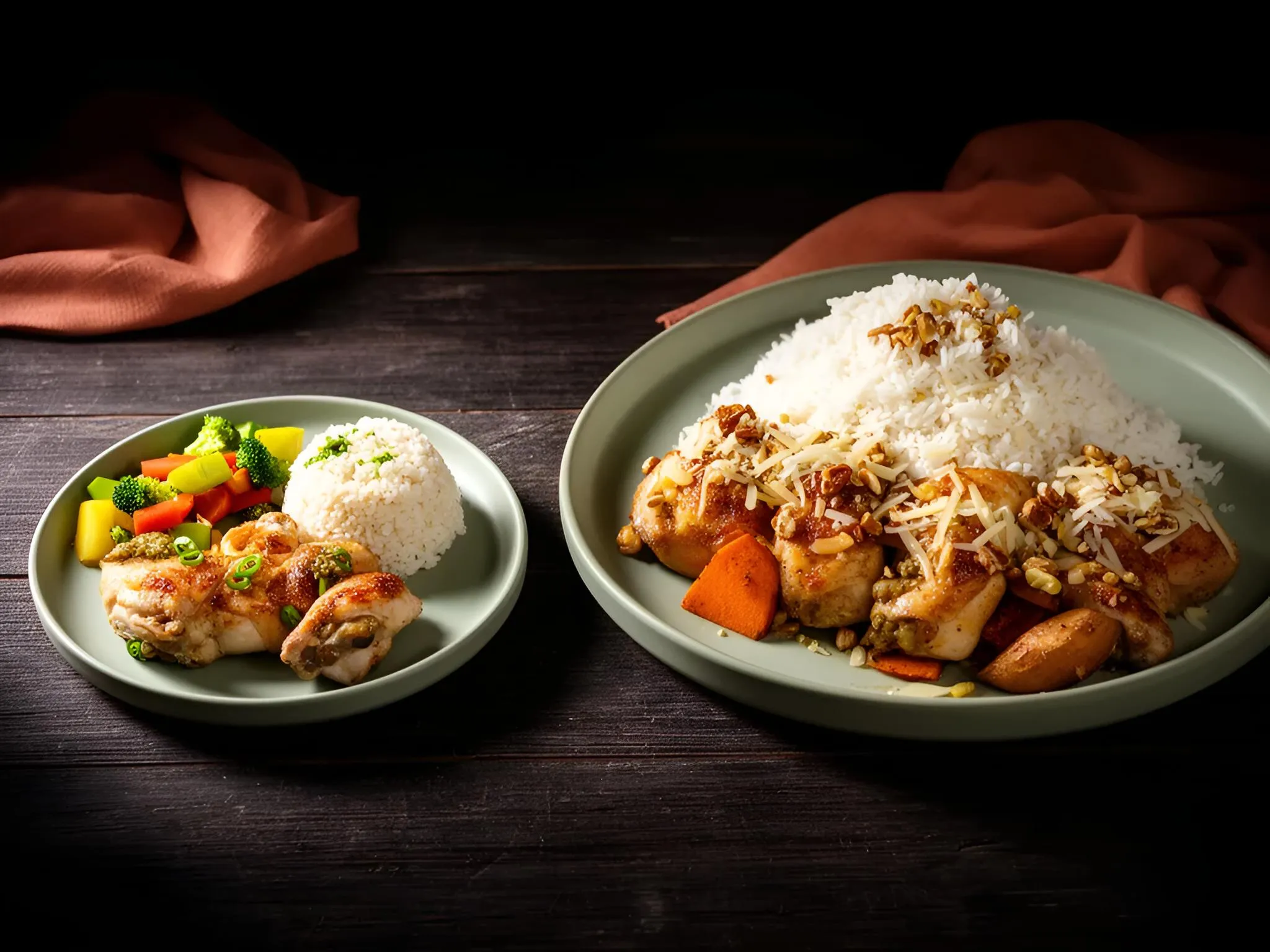
Same chicken. Same rice. Same chilli base. Partner B gets roughly double the protein, triple the rice, and a stack of calorie-dense extras that never appear on Partner A’s plate. The cooking session was shared. The plates diverge so far they look like different diets.
The levers that close a 1,500-calorie gap
When the gap is this wide, you need more than portion size to bridge it. Here are the levers, in order of impact:
- Carb volume. Partner B gets 2–3× the rice, oats and sweet potato. This alone adds 500+ calories.
- Calorie-dense extras. Peanut butter, nuts, olive oil, cheese, avocado — added only to the bulk plate. Each adds 100–200 calories per serving.
- Protein scale. Both plates get adequate protein, but Partner B’s portions are 60–80% larger.
- Liquid calories. A mass gainer shake or smoothie with banana, oats and peanut butter can add 500–800 calories without making the bulk partner feel overfull.
Common questions
What if the cutting partner is always hungry?
How do we handle eating out?
Can we do this without tracking macros?
What happens when one of us switches from cutting to maintenance?
Related reading
- One Meal, Two Plates: The Complete Guide — the full method behind the portion split
- How to Cook One Meal for Two Different Macros — the macro maths for two targets
- Couples Meal Prep Sunday — the batch-cooking system for the whole week
- How to Stop the “What’s for Dinner?” Argument — why a shared plan ends the nightly stand-off