
How to Cook One Meal for Two Different Macros
The full macro maths: protein floors on a cut, surplus targets on a bulk, and exactly how to split one recipe into two plates that each hit a different macro target.
The problem: two targets, one recipe
You track your macros. Your partner tracks theirs. The numbers are nothing alike — one of you is eating 1,500 calories to cut, the other is eating 2,800 to build — and every recipe you find serves four identical plates. So you either cook twice (and spend your evening washing two sets of pans), or you cook once and one of you quietly misses your target.
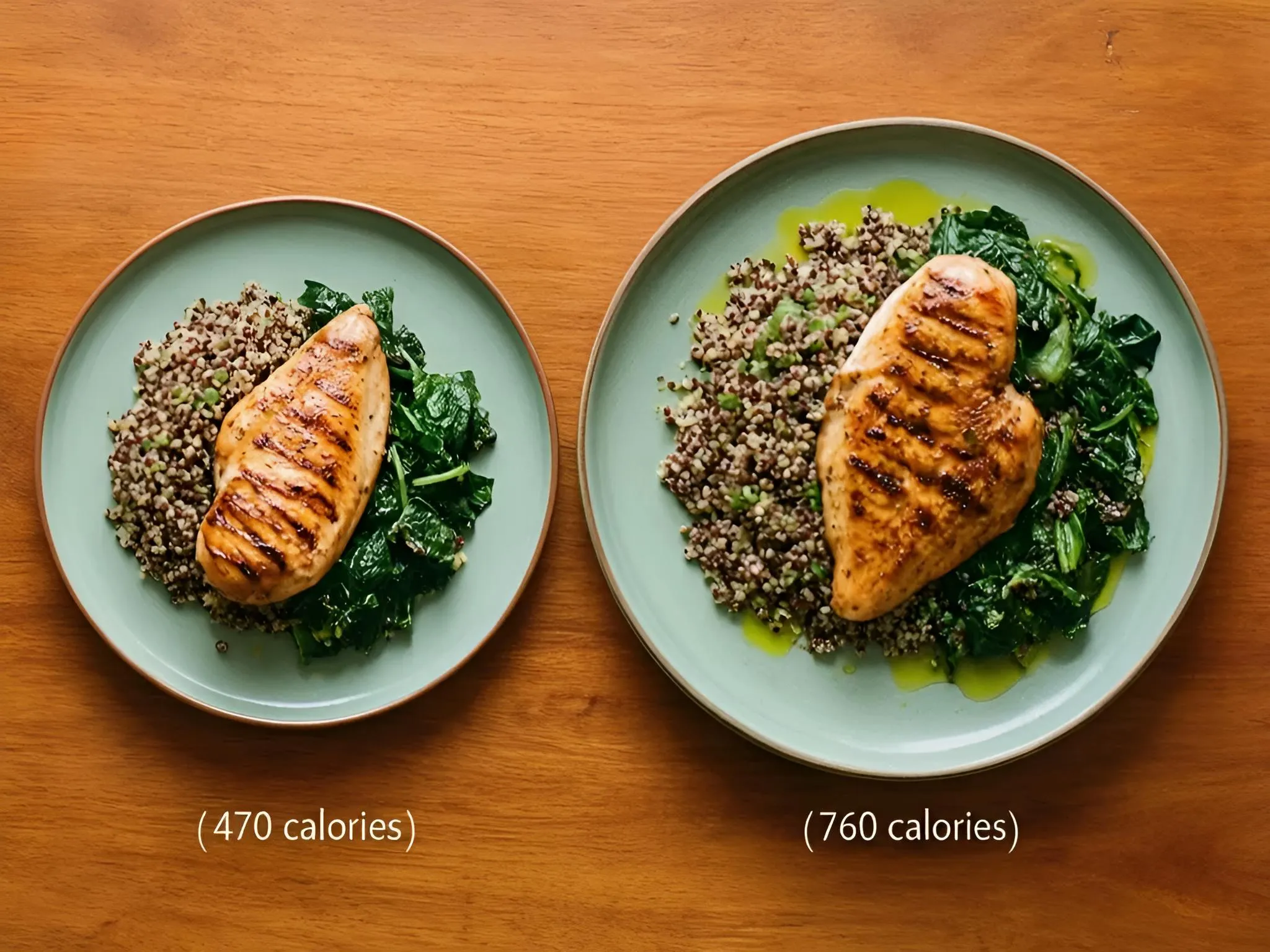
There is a third option, and it is the one this post is about: cook one shared recipe and plate it two ways, with each plate sized and balanced to hit a different macro target. The cooking step is shared. Only the plating diverges. We covered the high-level method in our complete guide to one meal, two plates; this post is the deep dive on the macro maths — protein floors, calorie splits, and how to move the levers without cooking anything extra.
Step 1: Know each person’s daily target
Before you can split a meal, you need to know what each plate is aiming for. That starts with TDEE — Total Daily Energy Expenditure — which is your resting metabolic rate multiplied by an activity factor.
The resting rate is most often estimated with the Mifflin–St Jeor equation, published in the American Journal of Clinical Nutrition in 1990 and still the standard for healthy adults. From there you subtract 300–500 calories for fat loss or add 300–500 for muscle gain. The US Dietary Guidelines put adult daily needs anywhere from roughly 1,600 to 3,000 calories depending on sex, age, size and activity — which is exactly the spread that makes one-size-fits-all portions fail.
For a single dinner, a reasonable rule is that it lands around 30–35% of the day’s total. So:
| Person | Daily Target | Dinner (~33%) | Protein Goal |
|---|---|---|---|
| Partner A | 1,500 kcal (cut) | ~480 kcal | 30–35 g |
| Partner B | 2,800 kcal (bulk) | ~920 kcal | 55–60 g |
You can verify any ingredient’s calorie and macro content on the USDA FoodData Central database. You do not need to hit your number to the single calorie — you need to be in the right range, meal after meal, and the maths takes care of the rest.
Step 2: Set the protein floor
Protein is the one macro you do not compromise on, regardless of whether the plate is for a cut or a bulk. The reason is muscle: protein protects lean mass in a deficit (so you lose fat, not muscle) and builds it in a surplus (so you gain muscle, not just fat).
A widely cited recommendation from the International Society of Sports Nutrition suggests 1.4–2.0 g of protein per kilogram of body weight per day for active individuals. For most people that lands between 100 g and 180 g daily. At dinner, roughly a third of that — so 35–60 g depending on the person.
The protein floor is the minimum that should appear on each plate. On the smaller plate (the cut), this might mean 120 g of chicken breast — about 38 g of protein. On the bigger plate (the bulk), 200 g of the same chicken — about 63 g. Same pan, different portions.
Step 3: Split the carbs and fats
Once protein is set on both plates, the remaining calories come from carbohydrates and fats. These are your levers — the things you move to make one plate bigger and the other smaller without touching the protein.
The levers, in order of how much they move the total:
- Carbohydrates (rice, pasta, potatoes, grains). The cheapest calorie lever and the fastest way to widen the gap. The bigger plate gets substantially more; the smaller plate gets less, sometimes none.
- Added fats (oil, butter, cheese, nuts, avocado). Small in volume, large in calories. A tablespoon of olive oil adds 120 calories in seconds — perfect for the surplus plate, too much for the deficit plate.
- Vegetables. The free lever. High in fibre and water, very low in calories. The smaller plate piles on extra veg to stay full without overshooting.
Step 4: A worked example
Dinner is a turkey chilli with rice. The full recipe — made once, for both of you — produces roughly 1,400 calories of chilli plus 600 calories of rice. Here is how it splits:
One pot. Two plates.
Same turkey chilli and rice — different portions, different macro targets.
Plate A · Cutting
~480 kcal
38g
Protein
35g
Carbs
14g
Fat
120g turkey chilli · ¼ cup rice · extra peppers and onions
Plate B · Bulking
~920 kcal
63g
Protein
98g
Carbs
28g
Fat
200g turkey chilli · 1¼ cups rice · cheese and sour cream
The method at the stove: cook the full recipe, plate the smaller portion first (120 g chilli, a small scoop of rice, extra vegetables), then give everything left to the bigger plate and top it with cheese and a dollop of sour cream. No second pan. No calculator at the stove.
When the gap is extreme
Sometimes the two targets are so far apart that a single recipe stretches awkwardly — a 1,200-calorie day next to a 3,200-calorie day, for instance. In that case, add a calorie-dense side to the bigger plate that does not touch the smaller one at all: a slice of toast with peanut butter, a handful of nuts, a banana with yoghurt. The shared meal stays shared; the surplus is layered on top.
This is also where the one meal, two plates method shines for non-calorie differences — a vegetarian and an omnivore, for example. The shared base stays the same; the protein component diverges at the end. (The deeper treatment of dietary mismatch lives in our guide to cooking for two different diet plans.)
Common questions
How much protein should be on each plate?
What if the calorie gap is too big for one recipe?
Do I have to weigh everything to the gram?
Can this work for three or four different targets?
Related reading
- One Meal, Two Plates: The Complete Guide — the full method, from picking a base recipe to plating for any combination of goals
- How to Stop the “What’s for Dinner?” Argument — the decision side of the same problem
- How to Meal Prep When One Partner Is Cutting and One Is Bulking — the fitness-couple version, end to end
- Pantry-First Cooking — building these meals from what you already have